

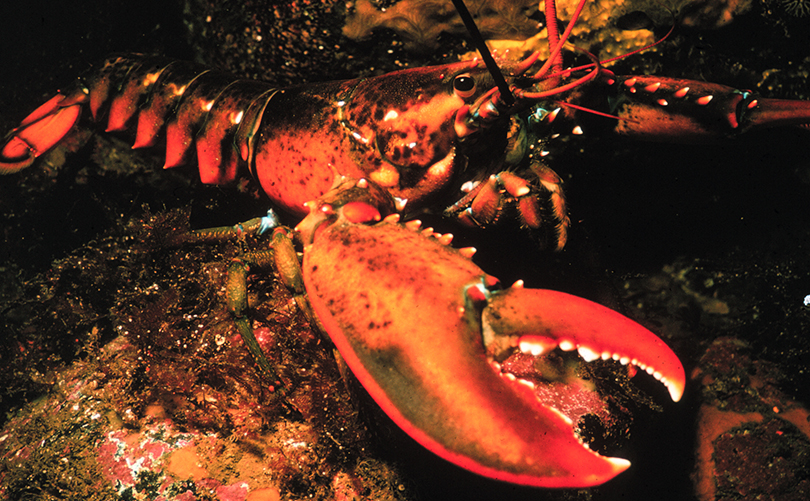
13 Feb Larval presence and settlement of the American lobster (Homarus americanus) in a changing southern New England estuary
Authors
Kristin Huizenga, Candace Oviatt
In the late 1980s and early 1990s, the American lobster (Homarus americanus) fishery flourished in southern New England. But by the early 2000s, lobster numbers in nearshore waters had sharply declined, and the fishery contracted. While researchers have studied falling adult populations and settlement patterns, lobster larvae had never been systematically sampled in Rhode Island waters.
From 2019 to 2021, weekly net tows at the mouth of Narragansett Bay and light traps inside the bay revealed that larval supply is extremely low and mostly limited to the East Passage, where ocean water enters the bay. Statistical analyses linking survey data, landings, settlement, temperature, and climate indices suggest that settlement declines followed the loss of adults along the Rhode Island coast but not inside the bay itself.
Together, the findings point to a key problem: Narragansett Bay depends on larvae transported from offshore spawning stocks. With changing circulation patterns and lobsters shifting into deeper waters, that supply line appears to be weakening thus making local recovery increasingly unlikely.
Image credit: NOAA Photo Library – OAR/National Undersea Research Program (NURP).